Tuesday, August 19, 2008

How good is Hemsky?

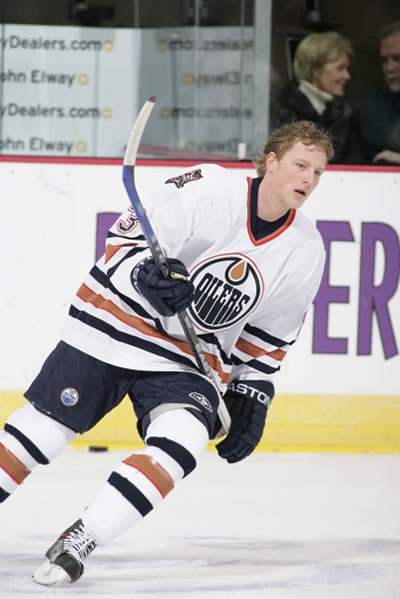
The topic of Ales Hemsky's status amongst the top players in this league has been debated a lot this summer. Not only is he the Oilers best player, but he's someone you got to love for his great skill, fluidity, and zeal to go at it regardless of what is being thrown at him.

A lot of people think Hemsky has 100-point potential, and I don't disagree, but I don't think we should be thriving on something as subjective as potential when talking about an established 25-year old player like Hemsky.

Let's talk about how he did last season stacked up against some comparable players, as well as some of the superstars of this league.

It's pretty easy to look at the overall point totals and rank Hemsky with the Brieres and Frolovs of the league. But once you take into account games played, minutes played, quality of competition and teammates (QC and QT), and breakdown of minutes played, Hemsky emerges in a completely different light (all this thanks to Desjardins)

Even Strength
Hemsky played the entire season on the first line, but had to put up with an entire half-season alongside Marty Reasoner and an out-of-shape, inconsistent Dustin Penner. He was the only legit first-line player on the team when Horcoff was out, yet managed to put up some respectable numbers along the way.
QC: 0.08
QT: 0.08
ESP/60: 2.36

Let's look at some other guys in the league that Hemsky gets compared to:

Name QC QT ΔQ ESP/60
Ales Hemsky 0.08 0.08 0 2.36
Martin Havlat 0 0.25 0.25 2.61
Marc Savard 0.1 0.15 0.05 2.32
Patrick Kane 0.02 0.36 0.34 2.32
Ryan Getzlaf -0.04 0.32 0.36 2.26
Eric Staal 0.07 0 -0.07 2.24
Mike Richards 0.05 0.11 0.06 2.21
Marion Gaborik 0.04 0.1 0.06 2.77
Daniel Sedin -0.01 0.14 0.15 2.09
Rick Nash 0.08 0.06 -0.02 2.01
Alexander Frolov -0.04 0.09 0.13 2.76
Anze Kopitar 0.02 -0.06 -0.08 1.86

The ΔQ is a denomination I kind of invented here to show the advantage/disadvantage gained by these players through the difference between their QC and QT. As you see, Hemsky not only does better than most of these players, but he does it without the significant advantage they have.
Let's compare Hemsky to some of the superstars of this league.

Name QC QT ΔQ ESP/60
Ales Hemsky 0.08 0.08 0 2.36
Sidney Crosby 0.03 0.22 0.19 3.38
Evgeni Malkin 0.05 0.2 0.15 3.20
Alexander Ovechkin 0.03 0.37 0.34 3.00
Vincent Lecavalier 0.13 0.02 -0.11 2.42
Joe Thornton -0.04 0.4 0.36 2.84
Martin St. Louis 0.11 -0.05 -0.16 2.03
Jarome Iginla 0.04 0.03 0.34 2.85
Marian Hossa 0.04 0.15 0.11 2.07
Henrik Zetterberg 0.13 0.56 0.43 2.83
Pavel Datsyuk 0.09 0.49 0.40 2.76

Something we see here is that a lot of these players get a ridiculous advantage with the ΔQ thanks to playing with other legit first-line linemates and defenders. There's no way we can compare him to the elite-3 (Malkin, Crosby, Ovechkin), but it's interesting to see how his offensive production can be compared to the likes of Zetterberg, Iginla, Datsyuk, and Thornton, who all capitalize upon an enormous advantage via the ΔQ to put up higher ESP/60. Another thing to note is how Hemsky has managed to usurp the likes of Hossa and St. Louis in terms of overall offensive effeciency at ES.

I think Hemsky has hit a level that puts him above the perennial 70-80 point scorers of the league when it comes to ES production. He's not ready to ride with the home-run hitters atop the leader board, but he's definitely up there with the 90 point scorers like Iginla, Thornton, and Datsyuk when you consider the ΔQ.
I think the biggest problem is Hemsky doesn't get enough ES time, something that has happened each season since the lockout. The aforementioned players really eat up the big minutes at ES with their respective clubs, and I think it's something we really need to look into for Hemsky. It'll not only help to lower his QC (other teams' shutdown pairings need a break, too), but will give him more chances to translate his great ESP/60 into higher totals in the points column.

Power Play
Here we hit Hemsky's specialty. Hemsky was the lone bright spot on an otherwise atrocious Oilers PP last season. He suffered through the losses of Horcoff and Souray for extended amounts of time, but managed to turn it up in the 2nd half of the year. We're not going to get any QC/QT values here, but I think it's safe to say Hemsky didn't have any significant advantages over other guys in the league in terms of QC considering the sorry state of the Oilers PP last year.
Here again are the guys we called "comparables" to Hemsky.

Name PPP/60
Ales Hemsky 5.93
Martin Havlat 2.25
Marc Savard 5.57
Patrick Kane 4.62
Ryan Getzlaf 5.83
Eric Staal 4.57
Mike Richards 4.46
Marion Gaborik 5.46
Daniel Sedin 4.87
Rick Nash 4.55
Alexander Frolov 3.33
Anze Kopitar 5.87

Hemsky easily wins out here, playing on a significantly lesser powerplay than these guys did.
Now, the superstars:

Name PPP/60
Ales Hemsky 5.93
Sidney Crosby 5.02
Evgeni Malkin 5.13
Alexander Ovechkin 4.55
Vincent Lecavalier 4.51
Joe Thornton 4.13
Martin St. Louis 4.79
Jarome Iginla 5.37
Marian Hossa 3.98
Henrik Zetterberg 5.20
Pavel Datsyuk 5.74

Hemsky trounces all of these guys in terms of powerplay point production. In fact, after Kovalev, Forsberg, Lehtinen, and Morrison, he was the 5th most effective powerplay forward in the league (even more impressive is that he and Kovalev were the only 2 to play more than 70 games).
Hemsky adds substance to what would otherwise be a bottom-5 PP in the league. Last year, Kovalev had a great supporting cast with Markov, Plekanec, and Kostitsyn to play with. Hemsky didn't have anywhere near the kind of talent to play with, but still put up all-star calibre numbers.
I wouldn't be surprised to see Hemsky get double-shifted in some games on the PP next season in order to improve the overall output of both units.

Summary
It's not hard to tell that Hemsky is one of the most offensively-gifted players in the league. He has shown amazing output in terms of ESP/60 and PPP/60, making him at least a top-15 player in the league when it comes to production in these situations. The problem that I see is that MacTavish is running a tight ship right now, and is not willing to hand out minutes like other teams are to their superstars. Hemsky rarely gets more than 18-19 minutes a game (compared to 21+ for a lot of the others), but has managed to put up amazing numbers regardless.

I think if Hemsky is going to take that next step, he's going to have to get more minutes. He has never shown signs of exhaustion in the past, and I think it's time for Mac-T to disregard any potential defensive troubles that arise with Hemsky on the ice, and look at what the team gains offensively with his presence. He should even consider trying him on the PK just to see how it goes (hey, even Ryan Smyth learned to become an effective penalty killer)

Now, I don't know the validity of Desjardins, but I've seen many other bloggers put out some legitimate arguments using these numbers. Regardless, I think it's safe to say that in Hemsky, the Oilers have an elite-level player who is ready to break out given the opportunity to do so.

Sunday, August 17, 2008

Why Colorado will be alright even without Sakic

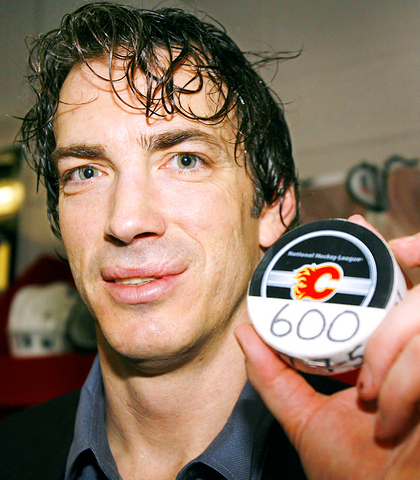
Joe Sakic looks pretty bewildered here after scoring his 600th career goal against the Calgary Flames. He scored 100 points in that 2006-2007 season, at the ripe old age of 37. He's one of the greatest offensive talents the game has ever seen, amassing six 100-point seasons over his career, and being one of the rare members of the 1000-assist club. At 39 years old, Burnaby Joe is now considering leaving the Avalanche for retirement, a move many have predicted would handicap the Avalanche heading into this season.

The loss of Sakic not only means that the Avs lose their captain, but they lose their top offensive weapon. But I think what a lot of us have forgotten is that the Avalanche are one hell of an offensive team, even without him and Brunette.

With Sakic gone, it is time for young Paul Stastny to assume the first-line center role. He will be accompanied by two 32-year olds, sniper Milan Hejduk and feisty Ryan Smyth. Both of them are capable of scoring 35+ goals given a legit set-up man. A healthy Smyth should do a lot for this top line, giving them someone to work the boards and the front of the net, and open up space for Stastny to operate and Hejduk to set up.

The second line is not so easy to predict. Youngsters Wojtek Wolski and Marek Svatos are coming off successful seasons, where both thrived alongside the brilliant Stastny. But with his promotion to the top line, who is there to fill the role?
T.J Hensick has been one of Colorado's top offensive prospects over the last couple of years, and finally broke in with the club for a few games last year, finishing the year in the playoffs with the club, putting up one point in 2 games. Many believe that the second-line spot is his for the taking.
If Hensick fails, Wolski will be shifted to the center position, a spot he's played before in junior. That 2nd line LW spot then goes to Darcy Tucker, a perennial 20-goal scorer that gives that line a gritty touch.
Either way, expect the offensive production on that line to be around 65 goals for next season, as Wolski's playmaking should do enough to make up for Stastny's absence.

The third line will be comprised of three gritty guys. Tyler Arnason is a capable 2-way player, and should excel in the bottom 6 alongside Ben Guite and character guy Ian Laperriere. They will get a lot of checking responsbility with the essential one-dimensional play (other than Stastny) of the top-6. Keep in mind if Hensick cracks the second line we'll see Tucker take Laperriere's spot here.

Rounding out the forwards are youngsters David Jones, who impressed late last year in the Avs' playoff push, and Cody McLeod, a kid who played steady in all 10 playoff games last year. T.J Hensick could be the center here if he doesn't crack the 2nd line. If he does, then expect to see Laperriere tutoring the kids on the line.

If you ask me, this offense will be in the top-3 in the division.

Now, I'll get to the goaltending last, but to make up for a potentially shoddy situation between the pipes, the Avs have assembled potentially the most defensively-sound blue line in the NHL (next to the Wings, of course).

Fresh off a brand new contract, John Michael Liles will be expected to carry the offensive load, and should get some big minutes playing alongside Adam Foote on the top line.

Although the loss of Kurt Sauer is a heavy one (in my opinion one of the most underrated defenders in the game), the Avs are going to have a sturdy replacement in proven veteran Ruslan Salei. He'll be paired alongside Brett Clark, who's 2-way game took huge strides last season. Together, they should be the second pairing, barring a Hannan/Leopold bounce back year, and should contribute a fair bit offensively while providing some solid shutdown potential.

The Avs are expecting huge bounce-back years from Scott Hannan and Jordan Leopold. Hannan, once considered a top-5 shutdown defenseman in the NHL, was atrocious last year, putting up a -4 plus/minus even after being relegated to second-pairing duty. Leopold has struggled to stay healthy since coming to Colorado, and regardless of putting up solid numbers when on the ice, needs to avoid injury if he's going to become a legit part of the team. If both can return to their true form, they should form a formidable, versatile pairing, and potentially challenge Liles and Foote for the most minutes on the team. The fate of these two players this year is a HUGE factor in determining just how good the Avs will be, they really need them to step it up.

I'd say the defense of the Avs is certainly top-2 in the division.

I know the goaltending sounds bad, especially the addition of Andrew Raycroft, but I think we're overreacting. Peter Budaj was being hailed as a legit starter by most Avs fans late in 2006-2007 when the team was making their late-season surge. He had a .905 SP on a formerly weak defensive team, and a 2.68 GAA. And this was including the early season struggles of the Avalanche. Last season, he was usurped by big-money Jose Theodore, but still managed to put up even better numbers as a back-up. I'd compare Colorado's situation right now in goal to the Oilers' at the beginning of the 2005-2006 season. You have a guy like Markannen in Budaj, who has proven over the years that he can be leaned upon when there's no one else, and someone like Conklin in Raycroft, where you don't know just what you're going to get with him. You never know what a fresh team might do for the kid, and if the Avs can grab a legit starter before the deadline while still contending for a spot, they're in prime position to make the playoffs or even win the division.

The goaltending is bottom-2 in the division as of now.

So there, even if the pundits are picking either the Oilers or Flames to win the division, I'd say we ought to keep our eyes peeled for the Colorado Avalanche, a team that regardless of potentially losing Sakic, may be a contender this season.

Thursday, July 31, 2008

Head Office Shuffling: Why?


"I plan to leave the management of the team and its public communications to the management."
-Darryl Katz, after finalizing his takeover of the Edmonton Oilers
"He wanted to allow us the management to strenghten our management group"
-
Kevin Lowe

Heading into this off-season, new Oilers owner Darryl Katz seemed to project an "hands-off" mentality when addressing how he would be involved in the daily running of things as the Oilers GM. But this move has all the makings of a Katzian decision.

I think we were all under the impression that things were going to be the same regardless of the ownership change. Lowe would continue to be the GM, and be the big player in the head office in terms of dealing with other teams, agents, and the running of the team.

But I think Katz noticed that some things needed to change over his first month as GM. Lowe is one of the most brilliant hockey minds in the game, someone more than capable of running a team. But his passion for the well-being of this organization has caused some tumultuous situations, and he is disliked by many prominent members of the hockey community (Burke, Winters, Regier). On top of that, the image of Edmonton had taken a considerable toll under Lowe's tenure as GM. That's not necessarily Lowe's fault, but people around the league are quick to associate his face with the city's poor image. Losing out on both Hossa and Jagr must have been disheartening for Katz, who usually is able to do what he wants in the business world. The idea of bringing a fresh, positive face to the front office would help in his goal of essentially turning this franchise, this city, and its image around in the future.

He looked around the league, and saw what was bringing teams success. The Detroit Red Wings, the top franchise in the NHL for the past decade, have always been known for their strong scouting staff. But on top of that, they have an exceptional management group aiding GM Ken Holland with running the club (Jim Devallano, Scotty Bowman, Steve Yzerman, and Jim Nill). Katz has been used to having a management group coordinate his business affairs (including with the Rexall Group), and it was only natural for him to take to this idea of accumulating a group of experienced, reknowned hockey minds in order to strengthen the overall management of the team. Investing money in brining in quality talent at the highest levels of a team's operations seems like a sensible way of improving the on-ice product.

With all this on his mind, Katz approached Lowe about the possibility of shifting things around. He respects Lowe and what his knowledge brings to this organization, but he was simply not ideal to have around as the guy to handle the day-to-day business interactions and dealings with other GM's. It would be better to have someone more amiable handle these responsibilities. He offered him the President of Hockey Operations position, basically giving him control of the entire hockey aspect of the Oilers franchise. I know it sounds like a figurehead kind of role, but it still gave Lowe control of the team's future, one he would implement using a management group of his choosing.

That being said, Katz wanted someone who would think on the same level of Lowe, sharing his view for the direction of the team. I think this is where he backed off and asked Lowe who HE would consider for the spot. Naturally, Lowe chose Tambellini, a guy he's worked with in the past as part of the Hockey Canada management group, and someone who shared his view and idea of how to run a hockey team. You can see him saying the same things Lowe has been.

"this is going to be a puck-possession team"
"we're going to be quick, skilled, and play with an edge"

Tambellini brings a fresh face to represent the club in its daily running, someone to deal with the agents, the GM's, and the media that have caused Lowe to lose 70% of his once luscious hair. But he also carries much respect and reputation in the league, and is someone Katz can trust the same way he trusts Kevin Lowe.

Major Changes in Upper Management

What a way to create a stir in one of the more boring weeks this off-season. The Edmonton Oilers today announced a trio of changes in the head office. Kevin Lowe, formerly the General Manager, is now President of Hockey Operations. Steve Tambellini, former assistant GM of the Vancouver Canucks, has been hired on by Lowe to be his successor (his first move as PoHO), while former Vice-President of Hockey Operations Kevin Prendergast has been shifted to the assistant GM spot alongside Rick Olczyk.

Surprise move, but if the Oilers were going to bring any outsider in for this spot, Tambellini was my first pick. He's worked with Lowe before on the 2002 and 2006 Olympic squads, and has plenty of experience with McTavish and other Oilers players when he was part of Hockey Canada's success at the World Hockey Championships from 2003-2004.

There's a lot to talk about this deal, including the motives, the new power breakdown, and what to expect looking forward. More to come on each of these topics in the days to follow.

How Howson Turned around a Trainwreck


The Columbus Blue Jackets remain the only franchise in the NHL right now that hasn't had a post-season birth. But with a slew of off-season changes and upgrades, we've seen them become legitimate playoff contenders here in the West. Credit has to go to former Oilers assistant GM Scott Howson, who was able to transform himself from a capologist to a legitimate hockey mind during his tenure here.

Entering the 2007 off-season, Howson had a disaster on his hands. The Blue Jackets were not only basement-dwellers, they were stagnating as a team in terms of player development and overall outlook. Former GM Doug McLean had failed to fulfill any of the pre-expansion promise he had shown before the team had materialized, and after 7 years of failure, it was time for a change.

Although the Jackets didn't improve at all last year, Howson and Co. were able to make some changes that not only opened up tons of cap space for the team, but improved their outlook heading into this offseason. Here are a few of the moves:

2007-2008
1) Signed Jan Hejda to a 1-year deal, before extending him for 3 more
-Hejda is arguably one of the NHL's best defensive defenseman, and will be a rock for years to come on the CBJ blue-line
2) Signed Jiri Novotny to a 2-year deal, and Chimera to a 4-year extension
-Novotny emerged as a solid 4th-line player for the Jackets last season, and put up 22 pts. One of the league's most underrated 3rd liners, Chimera is a solid 2-way presence
3) Dealt both Adam Foote and Sergei Fedorov at the deadline for a 1st and 2nd pick, respectively
-Major salary unload, while opening up roster space for next year, and grabbing solid picks to build up the prospects.

With some key components re-signed, and plenty of cap room freed up, Howson made his moves in the 2008 offseason:

2008 offseason
4) Signed Mike Commodore to a 5-year contract
-Commodore struggled to find his niche with Philips and Volchenkov already occupying it with the Senators, but should be a dominant force along with Hejda over this contract term at shutting down the opposition
5) Signed Kristian Huselius to a 4-year contract
-This granted Rick Nash his set-up man, and really helps boost the lacklustre offensive attack the BJ's had.
6) Traded Nikolai Zherdev for Christian Backman and Fedor Tyutin
-With Huselius signed, Howson moved Zherdev for 2 above-average defenders. Backman will help boost the break-out, while Tyutin's solid 2-way play adds to the top-4 in Columbus. This more than makes up for the loss of Ron Hainsey, who signed an inflated contract with the Thrashers
7) Traded for the rights to R.J Umberger, and signed him to a 4-year contract.
-This move gives them depth down the middle, and Umberger, with his untapped offensive potential, should have legitimate chances to shine alongside Nash and/or Huselius
8) Signed Mike Peca and Mike York to cheap, cheap deals
-These two players, although their careers are taking dives, will provide great leadership, depth, and some solid bottom-6 play when the BJ's need it.
9) Traded Gilbert Brule to the Oilers for Raffi Torres.
-They got rid of essentially a dead-end prospect in Brule for a proven 20-goal scorer in Raffi Torres. Both of these guys needed a change of scenery. Torres will get plenty of chance to shine in the top-6, and should return to 20+ form.
10) Re-signed Pascal Leclaire to a 3-year contract
-The guy emerged as a legitimate starter with the BJ's last season. He's young, he's fresh, and Howson got the deal done before his value skyrocketed.

With these 10 moves, Howson has created a legit playoff team here. Not only are a lot of these guys underrated (Hejda for example), but they have great coach in Hitchcock to help them further improve.

Nash Umberger Huselius
Torres Malhotra Voracek
Chimera Peca Novotny
Brassard Murray Filatov
Svitov
York

Hejda Commodore
Klesla Tyutin
Backman Russell
Tollefsson

Leclaire
Norrena

How about that, that gives the Blue Jackets plenty of room to work with their young players, while they have solid guys like Huselius and Commodore around to lead them. This team is going to grow, and if not this year, will be serious contenders in the years to come with the prospects they're accumulating and with the great leadership of Scotty Howson.

How far can Brodziak go?


Kyle Brodziak is one of the more interesting Oilers youngsters. The guy was drafted to be a 2-way presence and solid bottom-6 player, and after a few years of tumultuous development, we're seeing him blossom into a great NHL player. The knocks on him after being drafted were his speed and offensive skill, but he was able to overcome and both and make the NHL last season. It's hard to project just how far a kid like him can go.

Although it took Brodziak longer to become a player, he was able to grab the bull by the horns at age 23 and put up 80-14-17-31 playing on the 4th line all year.

Not only did he put up solid numbers in those limited minutes, we saw flashes of some of his undeveloped skills. Brodziak was a solid passer, solid shutdown presence on the PK and ES, a strong presence along the boards, and had a great shot. Remind you of anyone?

Shawn Horcoff broke into the league at age 23 and had 61-8-14-22 playing 4th line minutes with Laraque (Stortini) and Moreau (Glencross). Pro-rated to 80 games, he would have had slightly lower numbers than Brodziak in terms of points.

Brodziak's defensive game is even more advanced compared to Horcoff's at the same age, while Horcoff's speed back then was better than Brodziak's now. But with Brodziak working hard on his deficiencies, I really think he can eventually fulfill the same potential Horcoff did here.

Now, Horcoff was upgraded to that 2nd/3rd line role in his next full season, and put up a solid
78-12-21-33. This is essentially what Brodziak did last season, only he was younger and had less minutes.

If Brodziak can mirror or improve upon his stats from last year, while also maintaining the quality defensive play that he showed, he may be worth keeping for a very long time.


Tuesday, July 22, 2008

The Oilers PK, Part 2: Defensemen


Many held their breaths when the Oilers came into the 07-08 campaign. Although they had struggled the year before, they had still managed to be among the top-5 PK teams in the league, thanks to the likes of Jason Smith and Jan Hejda. With only Staios and Greene left as defensive stalworths, the Oilers were left to fend on the PK with a bunch of offensive-minded defensemen. Once again, a few surprises when we look at the GA/60min:

Souray: 3.68 (3.77 mpg)
Pitkanen: 3.94 (1.93 mpg)
Staios: 4.15 (3.71 mpg)
Gilbert: 4.88 (2.40 mpg)
Smid: 6.03 (2.30 mpg)
Greene: 7.20 (2.54 mpg)
Grebeshkov: 8.96 (1.13 mpg)

Now, with all the injuries, even guys like Grebs were getting some minutes on the PK.

Anyone surprised with Souray? Who knew the guy we were labeling as a defensive failure is our best PK, playing the most minutes? His big body presence was a much-needed relief. He effectively cleared the front of the net, and was able to smartly move the puck out when there was too much pressure. Hopefully he stays healthy so that great play continues alongside Staios.

Pitkanen's defense also took a beating while he was here. But the guy could flat-out play. Although you wouldn't see him being physical, he was effective in another way. Teams couldn't dump-and-chase with him on the ice, cause he'd beat them to the puck and clear it out. He was also effective at burning SH time by skating the puck out or feeding it up to the forwards. It proves you don't have to be a Gator in order to have success on the PK.

Staios was clutch, and is going to be expected to carry the same load again this year. Gilbert's numbers were even better earlier on in the year, and faded near the end. He may see more minutes with Greene's departure, alongside either Smid or Visnovsky.

Smid and Greene received too much credit as a pairing last year. They played soft minutes, and were terrible on the PK. Who would have thought the "shutdown defenseman" Greene was going to be one of the worst defenders we had on the PK. Both these guys had questionable decision-making and positioning throughout the season. Good riddance with Greene and hopefully Laddy learns how to play.

Grebeshkov is the last guy you'd expect to play PK, and his numbers reflect it. He's not here to play those SH-minutes though, and we all know that. His role is strictly PP/ES.

Oh yeah, and here's why Visnovsky's shouldn't see PK time:

Visnovsky: 6.43 (1.37 mpg)

It's kind of cool how these numbers kind of match up with one of my predictions in an earlier post (I swear I never consulted them before this):
Oilers PK Minutes Predictions

If Souray doesn't stay healthy, the Oilers PK is going to be even worse than last year. Otherwise it could be slightly better then last year.